Aligning Change Management with ESG: Addressing Communication Hurdles
Hivatkozás:
Lajó Adrienn (2025). Aligning Change Management with ESG: Addressing Communication Hurdles. Jel-Kép: Kommunikáció, Közvélemény, Média, (1.) 29-40. 10.20520/JEL-KEP.2025.1.29
Abstract
In today’s business environment, the integration of Environmental, Social, and Governance (ESG) principles has become essential for organizations. However, the path to adopting ESG frameworks often requires significant organizational change. This article explores the critical role of change management in facilitating ESG-driven transformations and the communication hurdles that arise during this process. Effective communication is the backbone of successful change, yet many organizations struggle with internal resistance, stakeholder misalignment, and transparency issues when implementing ESG initiatives. By examining the intersection of these, and communication challenges, this article offers strategies for overcoming these obstacles. It highlights the importance of clear messaging, stakeholder engagement, and transparency to ensure that ESG efforts not only comply with standards but also resonate with employees, consumers, and investors. Through effective communication and robust change management, organizations can navigate the complexities of ESG integration and thrive in a new business landscape.
Keywords
Introduction
In an increasingly dynamic business environment, organizations are compelled to adapt to external pressures, including technological advancements, market fluctuations, and growing societal expectations. Change management—the systematic approach to guiding organizations through these transitions—has emerged as a vital discipline for maintaining organizational resilience and competitiveness. Classic theories on change management, such as those outlined in Leading Change (Kotter 1996) and Kurt Lewin’s change model (1951), emphasize the importance of structured processes, leadership, and communication in navigating change. As these frameworks have evolved, they have been further linked to emerging themes such as the integration of Environmental, Social, and Governance (ESG) principles, which add an additional layer of complexity to organizational transformation.
The rise of ESG in corporate strategy is reshaping how businesses operate and make decisions. According to Social-impact efforts that create real value (Serafeim 2020), companies are increasingly recognizing that sustainable practices, ethical governance, and social responsibility are not just regulatory or moral imperatives but key drivers of financial performance and long-term success. ESG is no longer viewed as a stand alone initiative but as a fundamental aspect of business strategy, which necessitates a comprehensive approach to change management. As organizations strive to implement ESG frameworks, they often encounter substantial hurdles.
Moreover, the rapid pace of technological innovation has placed additional pressure on organizations to be agile. Dong Xiaojing and Shelby H. McIntyre in The Second Machine Age (2014) emphasize how technological advancements are disrupting traditional business models, leading to both opportunities and challenges in organizational change. Companies are now expected to adopt new digital tools, automation processes, and data-driven decision-making, while simultaneously embedding ESG principles into these new frameworks. The confluence of technology, market changes, and ESG imperatives creates a complex landscape where traditional change management practices must be reimagined.
The Fifth Discipline (Senge 1990) introduces the idea of a learning organization, where companies constantly evolve by fostering an open culture, encouraging collaboration, and leveraging systems thinking.. As markets become more volatile and ESG expectations grow, companies are expected to be transparent, accountable, and agile-qualities that depend heavily on how effectively change is managed.
This article is motivated by the need to bridge the gap between established theoretical models and the practical challenges organizations face when implementing ESG initiatives. Accordingly, our research questions are designed to explore how ESG frameworks complicate traditional change management approaches, identify the communication challenges that arise during ESG integration, and determine strategies to align ESG goals with organizational values. To address these challenges, this study employs a qualitative research design, incorporating a systematic literature review and targeted case study analyses, to examine the integration of ESG principles within change management strategies.
Research problem and questions
Many organizations struggle with the effective implementation of ESG frameworks within their change management strategies. This struggle is exacerbated by communication barriers, resistance to change, and difficulties in harmonising diverse stakeholder interests. Despite significant literature on change management and ESG, the gap between theoretical frameworks and practical implementation persists.
How do ESG frameworks complicate traditional change management approaches?
What are the primary communication challenges organizations face when integrating ESG into their operations?
How can organizations overcome resistance to ESG-driven change, particularly from internal stakeholders?
What strategies can be employed to ensure alignment between organizational values, ESG goals, and stakeholder expectations?
Discussion
ESG and Change Management
The integration of ESG frameworks into organizational strategies demands both operational and cultural shifts, requiring change management practices that go beyond traditional approaches. Change management is defined (Armenakis et al. 1993) as the process of preparing, supporting, and helping individuals, teams, and organizations navigate the transition from their current state to a desired future state while maintaining or improving performance. This involves several critical areas, such as strategic alignment, stakeholder engagement, and continuous improvement.
Strategic Alignment: Organizational changes, particularly those driven by ESG, must be closely harmonised with the company’s broader strategy and objectives. As ESG principles challenge traditional profit-driven models, organizations must find ways to harmonize financial performance with environmental and social goals.
Stakeholder Engagement: Engaging stakeholders – including employees, investors, customers, and communities – is crucial to the successful implementation and sustainability of any change. Freeman’s Stakeholder Theory (1984) highlights the importance of considering multiple interests in organizational decisions, a key concern in ESG-driven transformations. Ensuring that stakeholders understand the value and rationale of ESG initiatives is essential for overcoming resistance and ensuring long-term buy-in.
Continuous Improvement: Change management doesn’t stop once changes are implemented; it involves ongoing monitoring and improvement. As noted by Senge (1990), organizations must embrace lifelong learning and continuously adapt to ensure that changes remain relevant and effective. In the context of ESG, this means regularly revisiting sustainability goals and adjusting strategies in response to evolving societal, environmental, and market conditions.
A significant body of research underscores the importance of integrating ESG criteria into corporate strategies to enhance sustainability performance. One study used network analysis and content analysis to examine the growing emphasis on ESG criteria, finding a peak in research articles in 2021 (Boiral 2007). This trend highlights the increasing attention organizations are paying to sustainable development and the simultaneous concern for economic performance.
Regarding internal changes: ESG-driven change necessitates cultural shifts that may disrupt traditional power structures and policies. For example, companies that embrace ESG in a meaningful way create a shared value that benefits both society and business (Serafeim 2020).
As to external changes are concerned, as McKinsey (2020) highlights, ESG’s direct influence on market positioning and investor relations drives its adoption, making change management crucial for companies seeking to balance financial objectives with broader sustainability goals.
Communication Challenges
The theories behind: Effective communication is pivotal to ensuring the success of ESG-related change management. According to John P. Kotter’s Leading Change (1996), a clear and compelling vision for change must be communicated to gain organizational support. In ESG, this involves making the case for why sustainability and governance reforms are essential for long-term success. However, one of the main challenges is bringing the stakeholder expectations into agreement, particularly when ESG goals do not appear to provide immediate financial returns. Heide et al. (2018) emphasize that consistent, clear messaging is vital to overcoming this barrier.
An emerging area of focus is the communication of climate change-related ESG criteria. Companies and investors are increasingly aware of the material risks posed by climate change and are improving the availability and reliability of climate-related financial information. Regulatory requirements are pushing organizations to integrate more transparent climate-related disclosures into their ESG reporting, which can help mitigate risks and enhance decision-making.
As pointed out by Heracleous and Barrett (2001), employees may struggle to see how ESG goals relate to their everyday roles. Clear, ongoing communication about the broader impact of these initiatives can reduce scepticism and foster engagement. This aligns with the perspective of Kenneth E. Boulding (1966), who argued that organizations and societies operate within knowledge structures that shape decision-making and perception. From an ESG perspective, this suggests that sustainability-related communication is not just about sharing information but also about reframing how stakeholders conceptualize risks, responsibilities, and long-term value creation.
Similarly, Fischer (2019) highlights the importance of Nachhaltigkeitskommunikation (sustainability communication), emphasizing that companies must create credible, transparent ESG narratives to avoid accusations of ’greenwashing’ and strengthen internal and external engagement. Besides this, with an increased focus on transparency, companies must ensure that their ESG reporting meets the growing demands of investors and consumers for reliable, clear, and actionable information. Eccles and Klimenko (2019) argue that transparent ESG disclosures are essential to building trust and preventing accusations of ’greenwashing’. Freeman’s Stakeholder Theory (1984) emphasizes the need to address the expectations of a wide array of stakeholders. This also becomes particularly challenging when balancing financial performance with the demands of ESG commitments.
A similar perspective is found in Schaltegger, Burritt & Petersen (2017), who argue that effective Nachhaltigkeitsmanagement (sustainability management) requires integrating structured ESG communication strategies with performance reporting to streamline corporate decision-making with stakeholder expectations. Boulding’s insights reinforce the idea that ESG communication must transcend transactional reporting and become a transformational process, where businesses actively shape how stakeholders perceive and engage with sustainability issues. This highlights the need for an integrated approach, where ESG messaging is embedded within broader organizational knowledge frameworks, ensuring that sustainability becomes an inherent part of decision-making rather than an isolated compliance requirement.
Practical examples
Following Kotter’s (1996) principle, Unilever has consistently communicated a clear vision for sustainability through its Sustainable Living Plan (launched in 2010). The initiative outlined how sustainability is integrated into business growth, emphasizing long-term value rather than just short-term financial gains – a clear and compelling vision. Unilever recognized that adhere ESG goals with diverse stakeholder expectations could be challenging, particularly with investors concerned about financial returns. To address this, the company provided transparent data linking sustainability efforts to business performance, demonstrating that ESG initiatives drive cost savings, brand loyalty, and risk mitigation. As Heide et al. (2018) emphasize, consistent and clear messaging helped Unilever balance investor concerns while engaging customers and employees in sustainability efforts. Eccles and Klimenko (2019) argued that transparency is key to building trust and preventing ‘greenwashing’, which Unilever addressed by adopting globally recognized ESG reporting standards such as the Global Reporting Initiative (GRI) and Sustainability Accounting Standards Board (SASB) frameworks.
Freeman’s Stakeholder Theory (1984) highlights the challenge of balancing financial performance with ESG commitments. Unilever’s strategy has shown that sustainability and profitability are not mutually exclusive—the company’s sustainable brands, such as Dove and Ben & Jerry’s, have consistently outperformed their conventional counterparts.
Overcoming Resistance to ESG-Driven Change
The theories behind: Resistance to change is a common barrier in organizational transformation, often stemming from fear of disruption or perceived irrelevance of the change to core business activities. Armenakis et al. (1993) highlight the need to support and guide individuals through the change process. Resistance to ESG-related changes may be particularly pronounced when employees or leaders view sustainability initiatives as diverting resources from traditional business goals.
Kegan and Lahey’s Immunity to Change (2009) suggests that addressing these concerns requires understanding the underlying psychological barriers to change. Furthermore, Bridges’ Transition Model (1991) argues that change management must focus on the human side of transitions, helping employees not only accept but actively participate in the new ESG initiatives.
We can identify two major tracks as solutions: Leadership as Change Agents: Schein (2010) argues that leadership is central to changing organizational culture. Leaders must not only endorse ESG values but also exemplify them in their actions and decisions to inspire broader organizational commitment.
Education and Training: Continuous education about ESG goals and their relevance to employees’ roles can significantly reduce resistance to change. Argyris and Schön (1996) note that organizational learning is key to adapting successfully to ESG-driven changes.
Practical examples
To illustrate the challenges of overcoming resistance to ESG-driven change, the case of Unileverprovides a valuable example. Under the leadership of CEO Paul Polman(2009–2019), Unilever embraced a strong sustainability agenda, launching the Unilever Sustainable Living Plan (USLP) in 2010. The plan sought to decouple the company’s growth from its environmental footprint while increasing its social impact. However, the initial implementation faced significant internal resistance, especially from stakeholders who viewed the sustainability goals as conflicting with traditional business objectives, such as profit maximization.
Unilever’s leadership, under Polman, acted as the key change agent, emphasizing that ESG goals were not merely „add-ons” but integral to the company’s long-term success. He restructured the company’s incentives to conform sustainability with business performance, making it clear that profit and purpose could coexist. This leadership commitment helped overcome skepticism and engage employees by connecting ESG goals directly to business outcomes, aligning with the argument that leadership plays a central role in shaping and changing organizational culture (Schein 2010).
Education and training were also critical in reducing resistance. Unilever invested heavily in educating its workforce on the importance of sustainability, demonstrating how ESG efforts aligned with individual roles and the company’s overall strategy. Continuous education on sustainability principles and their application across various business units helped employees see the relevance of ESG to their day-to-day activities. This approach resonates with Argyris and Schön’s (1996)emphasis on organizational learning as a means to adapt successfully to ESG-driven changes. More recent studies also support this approach. A 2025 study by dos Reis Cardilloexamined how large multinational corporations successfully implemented ESG changes by promoting active employee participation and creating internal sustainability advocates, which helped reduce resistance and integrate individual efforts with broader corporate sustainability goals. The study found that companies fostering an inclusive and participatory approach were better able to overcome resistance and achieve ESG integration, further reinforcing the idea that leadership, education, and organizational learning are key to managing ESG-related transitions effectively.
As no existing theory had been found as general problem discussion regarding the problem of overcoming internal stakeholders’ resistance, the article attempts to use Grounded Theory for the research methodology – to implement theory to practice. The process of grounded theory describes specific strategies for analysis that can be incredibly helpful. While grounded theory is an open- ended methodology, it enabled us to stay structured and analytical.
We began by carefully reviewing case studies and scholarly articles, including Unilever’s transformation under CEO Paul Polman. During this phase, we extracted key concepts such as “strong leadership,” “clear internal and external communication,” “active stakeholder engagement,” “adoption of digital tools for ESG reporting,” and “ongoing process improvement.”
Next, we grouped these concepts into broader categories. For example, elements like leadership commitment and clear communication naturally clustered together as they both played crucial roles in mitigating internal resistance and aligning various stakeholders. Similarly, the adoption of technology and continuous education were grouped under operational enablers.
In the final phase, we integrated these categories around the central concept of ESG integration. The analysis revealed that while each factor is important on its own, their true value emerges when they collectively drive Strategic Alignment—the ultimate goal that ensures ESG initiatives become an intrinsic part of the organization’s overall strategy.
The resulting model visually represents how ESG Integration serves as the core around which the other factors revolve. Each factor—Leadership & Change Agents, Effective Communication, Stakeholder Engagement, Technological Support, and Continuous Improvement—directly contributes to achieving Strategic Alignment. This alignment, in turn, confirms that ESG efforts are fully integrated into the organization’s long-term objectives.
The whole exercise above made it possible to represent each factor via Unilever example in Figure 1.
Figure 1.
ESG efforts as factors integrated into long-term strategic objectives
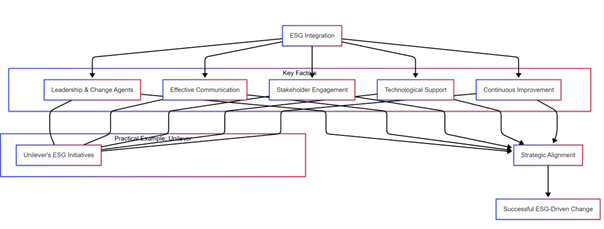
Leadership & Change Agents: At Unilever, CEO Paul Polman’s strong leadership was pivotal in reshaping the company’s culture and bridge sustainability with business performance.
Effective Communication: Unilever’s strategy involved clear, consistent messaging that helped employees and stakeholders understand the long-term benefits of ESG initiatives.
Stakeholder Engagement: Unilever engaged both internal teams and external partners (investors, suppliers, customers) to ensure broad support for its sustainability agenda.
Technological Support & Continuous Improvement: The company invested in new digital tools to monitor sustainability metrics, enabling continuous evaluation and improvement of its ESG strategies.
Strategic Alignment: These efforts converged to align Unilever’s operational changes with its overarching strategic goals, ultimately driving both business performance and sustainable development.
In the public sector, a notable example of overcoming resistance to ESG-driven change is found in the transformation of New York City’s public transportation system under the leadership of the Metropolitan Transportation Authority (MTA). The MTA faced significant resistance when it introduced a comprehensive plan to modernize its infrastructure with a focus on sustainability and environmental responsibility. This plan aimed to reduce the system’s carbon footprint, enhance energy efficiency, and prepare for climate change impacts, particularly after the devastation caused by Hurricane Sandy in 2012.
Many stakeholders within the MTA and the broader public initially resisted the change, viewing the sustainability initiatives as costly and disruptive to daily operations. Some employees and unions feared that the changes would lead to job cuts or require significant retraining. Additionally, some leaders within the organization viewed the focus on sustainability as diverting attention from the core mission of maintaining and expanding the existing transit system.
To overcome this resistance, the MTA leadership acted as the key change agents, communicating the long-term benefits of the sustainability initiatives. They emphasized that modernizing the system with ESG principles was not only about environmental responsibility but also about improving reliability, safety, and resilience—especially in the face of future extreme weather events. These efforts reflected Schein’s (2010) assertion that leadership is essential in shaping organizational culture and overcoming resistance by embedding ESG values into strategic goals.
Education and training were also vital. The MTA provided its employees with the necessary skills to adapt to the new technologies being introduced, such as energy-efficient trains and renewable energy systems. The organization also made a concerted effort to engage the public, explaining how the changes would benefit not just the environment but also the quality of service for commuters, making the transportation system more reliable and resilient. This integrates Argyris and Schön’s (1996) theory that continuous learning and education are critical to successfully implementing ESG-driven change.
A 2015 study by Ehnert et al. examined the resistance to sustainability initiatives in public services, including the MTA, and found that public institutions that engaged in transparent communication and ongoing stakeholder education were more successful in reducing resistance. In the MTA’s case, leadership’s commitment to sustainability, coupled with its efforts to involve both employees and the public in the transition, helped shift perceptions and reduce resistance.
The MTA’s experience shows that even in the public sphere, where resistance can be particularly strong due to entrenched bureaucracies and complex stakeholder dynamics, ESG-driven changes can be successfully implemented with strong leadership, clear communication, and investment in education and training. This case highlights the importance of aligning public services with broader environmental and social goals, demonstrating that ESG principles are not just for private corporations but also crucial in the public sector’s path toward sustainability and resilience.
By using both leadership and educational strategies, organizations like Unilever and others have shown that it is possible to overcome resistance to ESG-driven change, especially when employees understand the long-term benefits and see clear connections between sustainability initiatives and business success.
Strategic Approaches for Success
The successful integration of ESG criteria within change management requires a comprehensive and strategic approach that includes stakeholder engagement, transparent reporting, and leveraging technology for data management. According to David Kiron et al. (2012), many leading organizations are employing technology to streamline their ESG initiatives, ensuring that they can accurately track and report progress against sustainability goals.
One of the key areas for success is the integration of climate change into ESG reporting. As Boiral (2007) suggests, climate action is increasingly becoming a priority within ESG frameworks. This raises questions about whether climate change should be treated as a separate category given its global importance and direct impact on various industries.
The Missing Link: External Reporting and the Promise of Transparency
A critical aspect of ESG communication is external reporting, where companies demonstrate their commitment to sustainability and governance to the outside world. How Does Organizational Learning Enable ESG Performance (Xia 2022), highlights that companies with a culture of continuous learning and adaptation are better equipped to effectively report ESG performance. This organizational learning culture allows companies to stay ahead of regulatory changes, adapt to new sustainability challenges, and provide comprehensive, transparent ESG reports.
In addition to organizational learning, Baratta et al. (2023) focused on the impact of ESG practices in reducing carbon emissions, emphasizing the growing demand for transparency in reporting environmental impacts. This research illustrates the increasing pressure on companies to provide accurate, detailed data on their environmental footprint, especially in terms of greenhouse gas emissions—a key area of ESG reporting.
As ESG reporting evolves, we are seeing a shift from voluntary disclosures to mandatory, sector-specific reporting frameworks driven by regulatory demands and stakeholder expectations for transparency. Companies are not only expected to report on ESG performance but also to demonstrate continuous improvement and accountability in areas like climate change. These studies underscore the importance of integrating ESG criteria into corporate strategies, with external reporting being the key to ensuring transparency and accountability to the public. By (2005) argues that effective change management requires aligning internal changes with external communication to maintain stakeholder trust and support.
The evolution of ESG reporting frameworks presents opportunities and challenges for organizations. As companies navigate the complexities of reporting, they must also embrace continuous learning to ensure that their reporting is accurate, comprehensive, and reflective of their true ESG impact. The research by Xia (2022) and Baratta et al. (2023) suggests that companies that foster a culture of learning are better positioned to meet the growing demands of ESG reporting. This focus on transparency will be critical as companies face increasing scrutiny from stakeholders who expect detailed and reliable information on how organizations are addressing sustainability challenges.
Managerial Implications
ESG Complexity
Integrating ESG (Environmental, Social, and Governance) principles into organizational change management is a complex process that requires a multifaceted approach. It is not just about making procedural changes but also involves cultural shifts within the organization and leadership buy-in. For ESG integration to be successful, organizations must address how these principles affect their operations, decision-making processes, and overall strategy. This means that change management must account for different layers of the organization, from top leadership to day-to-day operations, and ensure that everyone is aligned with the ESG objectives. It requires rethinking traditional models, embracing new governance structures, and embedding sustainability and social responsibility into the company culture. The challenge lies
in ensuring that ESG efforts are not siloed but instead integrated into the fabric of the organization. This influences everything from corporate strategy to employee behavior and stakeholder engagement.
Communication Barriers
One of the main challenges in ESG integration is communication. Misalignment between stakeholders—whether internal, such as employees and management, or external, such as investors and customers—can significantly hinder progress. Clear and consistent messaging about the importance and value of ESG is essential for achieving buy-in and ensuring that everyone understands the organization’s sustainability goals. Without effective communication, ESG efforts can be met with confusion or scepticism, leading to disengagement or resistance from key stakeholders. Companies must focus on transparent, targeted communication strategies that address the concerns and expectations of different groups while highlighting the benefits of ESG initiatives. This includes explaining why ESG is critical not only for compliance but also for long-term business resilience and competitive advantage.
Importance of Leadership
Leadership plays a pivotal role in the success of ESG integration. Leaders must actively promote ESG values and ensure that they are strategically unified with the organization’s overall goals. Leadership is essential in driving change, managing resistance, and fostering a culture of sustainability and responsibility. Leaders must act as champions of ESG, not only by communicating its importance but also by demonstrating their commitment through their actions and decisions. When leaders prioritize ESG, it sends a powerful message to the rest of the organization that these initiatives are not optional but integral to the company’s success. Leadership is also critical in mitigating resistance to ESG-related changes, ensuring that any concerns or challenges are addressed in a way that adheres with the company’s values and long-term vision.
Technological Tools
The use of technology, particularly automation and data workflows, can greatly support the management and reporting of ESG initiatives. Technology can streamline the collection, analysis, and reporting of ESG data, making it easier for organizations to track their progress and ensure transparency. Automated systems can help reduce manual errors, improve efficiency, and provide real-time insights into ESG performance. Moreover, technology enables companies to meet growing demands for transparency from stakeholders by providing accurate, up-to-date reports on their environmental, social, and governance impact. As ESG reporting becomes increasingly standardized and regulated, the ability to leverage technological tools for effective data management will be critical in ensuring compliance and building trust with stakeholders.
Results
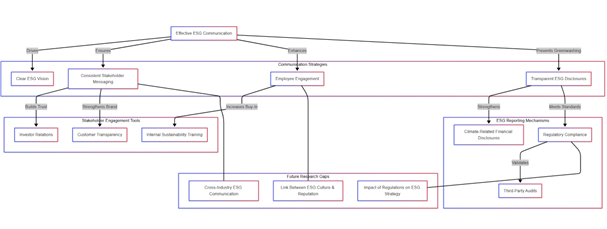
To explore the intersection of communication, ESG strategy, and organizational change, future practices can identify and draw up a modell within their organisation through the following steps:
Develop a conceptual model integrating communication strategies, ESG reporting mechanisms, and stakeholder engagement tools.
Use grounded theory to analyse real-world corporate case studies, identifying the most effective ESG communication practices.
Examine cross-industry differences in ESG communication effectiveness, assessing how regulatory environments and market pressures shape sustainability disclosures.
Investigate missing linkages between internal corporate culture and external ESG reputation, ensuring a holistic view of sustainability communication.
A visual model can be seen on Figure 2 below could illustrate these missing research gaps, mapping how communication processes, regulatory frameworks, and stakeholder relationships interact within ESG transformation.
Figure 2.
Visual model of interacting ESG transformation factors
Conclusion
ESG integration within change management is both essential and challenging. Organizations need to adopt comprehensive strategies that address not only operational and procedural aspects but also cultural shifts and communication complexities. Effective leadership, clear messaging, and the use of modern tools can ensure that ESG goals are embedded into the very fabric of the organization. To achieve long-term success, ESG initiatives must be seen not as stand alone efforts but as an intrinsic part of organizational identity and strategy. This cultural transformation requires educating and empowering employees at all levels to understand their role in achieving the company’s ESG goals. A culture of transparency, adaptability, and accountability is essential to ensuring that ESG principles are reflected in every aspect of the organization’s work. As regulatory frameworks around ESG continue to tighten, organizations that leverage technology will be better equipped to meet these demands and remain competitive in a sustainability-driven marketplace. his holistic approach to change management, where leadership, culture, communication, and technology come together, will ensure that ESG efforts are both effective and sustainable in the long run.
Areas of further Use And Call to Action
One critical area that requires further exploration is the role of technology in streamlining ESG (Environmental, Social, and Governance) data management, tracking, and reporting. While many organizations are embracing digital tools, there is a need for more research on how technological solutions can improve the accuracy, efficiency, and transparency of ESG reporting processes. This could include the development of automated systems for tracking environmental impact, social performance, and governance metrics, reducing manual errors and ensuring that data is collected and analysed in real-time. Furthermore, case studies across various industries are needed to understand how different sectors are tackling the integration of ESG into their change management strategies. Industries such as manufacturing, finance, or technology may face unique challenges when adopting ESG principles, and case studies can provide valuable insights into best practices and common obstacles. Research into these areas could provide a better understanding of how sector-specific factors influence ESG implementation and the change management required to support these initiatives.
For organizations to succeed in integrating ESG principles, communication and education must be prioritized as central components of their ESG strategies. Employees at all levels need to be aware of how ESG goals align with the company’s mission and their specific roles within it. A clear understanding of these objectives will foster greater engagement, reduce resistance to change, and promote ownership of sustainability initiatives. Training and ongoing education are essential to ensure that employees are equipped to contribute meaningfully to ESG efforts, particularly as standards and expectations continue to evolve.
In addition to fostering internal understanding, leadership must play a proactive role in championing ESG efforts. Leaders should not only articulate the importance of ESG but also embed these principles into the broader organizational objectives, ensuring that ESG is not seen as a separate or optional element but as an integral part of the company’s overall strategy. Leaders should inspire a culture of sustainability and accountability, leading by example and demonstrating their commitment to ESG through their decisions and actions.
By addressing these gaps in research and taking action to improve communication, education, and leadership around ESG initiatives, organizations will be better equipped to navigate the complexities of ESG integration. Successfully managing these challenges can enhance an organization’s competitive edge, as consumers, investors, and regulators increasingly demand transparency and accountability in ESG performance. Organizations that can effectively incorporate ESG into their operations will likely position themselves as leaders in a rapidly evolving market where sustainability and responsibility are key drivers of success.
References
- Argyris, Chris, Schön, Donald A. (1996) Organizational Learning II: Theory, Method, and Practice. Reading, Addison-Wesley.
- Armenakis, Achilles A., Harris, Stanley G., Mossholder, Kevin W. (1993) Organizational Change: A Review of Theory and Research in the 1990s. Journal of Management, 25. 293–315.
- Baratta, Alessio, Antonio Cimino, Francesco Longo, Vittorio Solina, and Saverino Verteramo. (2023). The Impact of ESG Practices in Industry with a Focus on Carbon Emissions: Insights and Future Perspectives. Sustainability, 15(8). 6685.
https://doi.org/10.3390/su15086685 - Boiral, Olivier (2007) Corporate Greening Through ISO 14001: A Rational Myth? Organization Science,18. 127–146. https://doi.org/10.1287/orsc.1060.0224
- Boulding, Kenneth E. (1966). The Economics of the Coming Spaceship Earth. In: Jarrett, Henry (1966 ed). Environmental Quality in a Growing Economy. Baltimore, Johns Hopkins University Press. 3–14.
- Bridges, William (1991) Managing Transitions: Making the Most of Change. Cambridge (MA), Perseus Publishing.
- By, Rune Todnem (2005) Organisational Change Management: A Critical Review. Journal of Change Management, 5. 369–380. https://doi.org/10.1080/14697010500359250
- Dong, Xiaojing, and Shelby H. McIntyre. (2014) The Second Machine Age: Work, Progress, and Prosperity in a Time of Brilliant Technologies. Quantitative Finance 14 (11). 1895–1896. doi:10.1080/14697688.2014.946440.
- dos Reis Cardillo, Marcos Alexandre , Cruz Basso, Leonardo Fenando (2025): Revisiting knowledge on ESG/CSR and financial performance: A bibliometric and systematic review of moderating variables, Journal of Innovation & Knowledge,10/1.100648,ISSN 2444-569X. https://doi.org/10.1016/j.jik.2024.100648
- Eccles, Robert G., Klimenko, Svetlana (2019) The Investor Revolution. Harvard Business Review, 97(3). 106–116.
- Ehnert, Ina., Parsa, Sepideh., Roper, Ian., Wagner, Marcus., & Muller-Camen, Michael. (2015). Reporting on sustainability and HRM: a comparative study of sustainability reporting practices by the world’s largest companies. The International Journal of Human Resource Management, 27(1). 88–108. https://doi.org/10.1080/09585192.2015.1024157
- Fischer, Daniel. (2019). Nachhaltigkeitskommunikation. In: Zemanek, E., Kluwick, U. (Eds.),Nachhaltigkeit interdisziplinär.Konzepte, Diskurse, Praktiken.UTB, Stuttgart. 51–69
- Freeman, R. Edward (1984) Strategic Management: A Stakeholder Approach. Boston, Pitman.
- Heracleous, Loizos, Barrett, Michael (2001) Organizational Change as Discourse: Communicative Actions and Deep Structures in the Context of Information Technology Implementation. Academy of Management Journal, 44. 755–778.
https://doi.org/10.5465/3069414 - Kegan, Robert, Lahey, Lisa Laskow (2009) Immunity to Change: How to Overcome It and Unlock the Potential in Yourself and Your Organization. Boston, Harvard Business Press. ISBN 978 1 4221 1736 1
- Kotter, John P. (1996) Leading Change. Boston, Harvard Business Review Press.
- Kiron, David, Kruschwitz, Nina, Reeves, Martin, Fuisz-Kehrbach, Sabine K., Goh, Eyun-Jung (2012) Sustainability Nears a Tipping Point. MIT Sloan Management Review, 53. 69–74.
- Lewin, Kurt (1951) Field Theory in Social Science: Selected Theoretical Papers. New York, Harper & Row.
- Schaltegger, Stefan, Burritt, Roger, Petersen, Holger (2017)Nachhaltigkeitsmanage-ment: Einführung und Erfolgsfaktoren. Wiesbaden, Springer Gabler. ISBN 978-935630-60-3
- Schein, Edgar H. (2010) Organizational Culture and Leadership. John Wiley & Sons. San Francisco. ISBN 978-0-470-18586-5
- Senge, Peter M. (1990) The Fifth Discipline: The Art and Practice of the Learning Organization. New York, Doubleday.
- Serafeim, George. (2020) Social-impact efforts that create real value. Harvard Business Review, 98(5). 38–48.
- Xia, Yutao (2022) How Does Organizational Learning Enable ESG Performance? Journal of Corporate Accounting & Finance, 33(2). 94–104.
https://doi.org/10.3390/su142416962